“I’m hoping next week will be back to the standard gamedev posts. I’ve been making good headway on Doorways 9, but this idea kind of wedged itself in my brain over the weekend. That stuff is coming, I promise.“
The Four Horsemen of the Emailpocalypse – January 11th, 2024
I really gotta stop trying to put dates on things.
Hello! And welcome to my regularly-scheduled blog. I’ve been plugging away at development on Doorways 9 for the last few weeks, and have made some good progress. I’ve finally passed the first major milestone I set for myself this year: polishing off all the levels I started in 2023! Huzzah!
I’ve moved on to “new” levels – the ones I’ve had planned out for a while, but hadn’t gotten to yet. It’s a nice change of pace! But it also means I’m hitting the point where I probably shouldn’t be showing everything I do in public. I’ve got to keep something secret for the actual game release, after all :p
So today, I’m not going to be talking about the new and interesting stuff. Instead, this post is going to be about the part of game development that sucks.
The part that’s time consuming, boring, and – worst of all – entirely your own fault.
Let’s begin!
😀
Part 1: An Abyss of My Own Making
As the opening quote implied, things were going pretty smoothly for me at the end of January. I’d just finished up restructuring the oldest parts of my codebase, clearing out most of the bugs that had been kicking around over the holidays. The only thing left to do – before I could move on to that polish work I mentioned – was a single level: a mock-terms and conditions page.
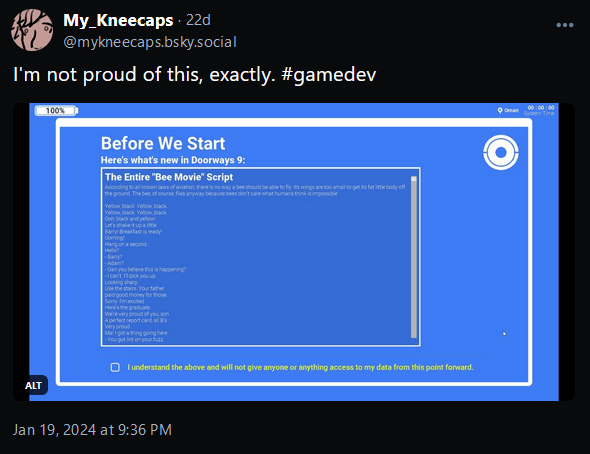
This level had been half-constructed in December, with a simple goal: the player has to scroll down to the bottom of an (unnecessarily) long license agreement, before the game allows them to accept and move on. In many ways, it’s more joke than level – though it’ll also be a fun test for me to see how many players know about the PgDn key.
I left this scene unfinished as I worked on bug-fixing, with the entire script of DreamWorks Animation’s The Bee Movie (2007) standing in for my fake Terms-of-Use. Eventually, though, I finished the code – and had an alarming realization:
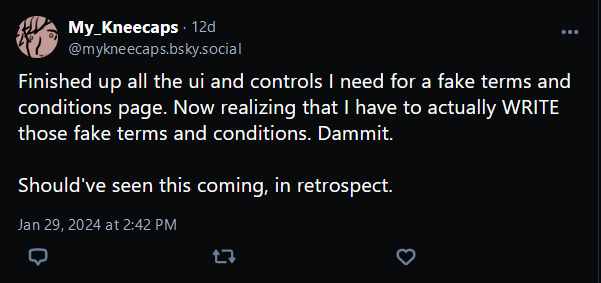
Pictured: Hubris at work.
Whoops.
Now, I do tend to enjoy writing – in case this blog didn’t make that obvious. But this was writing filler – an entire document’s worth of words whose purpose was, essentially, to be ignored.
The easy way of doing this would be to populate the page with random garbage – stuff that would take no effort on my part, since the player shouldn’t be reading it anyway. That’s already what I was doing with my Bee Movie placeholder, except this time with less copyright infringement.
This, unfortunately, is where you hit the common snag that permeates all aspects of interactive game design: the player. Sure, I could fill the page with gibberish – but what if the player simply stopped scrolling? What if they tried to read something?
It doesn’t really matter, of course. That’s not the point of the level. It’s a License Agreement. The joke is that no one reads those. It’s only there to make them scroll for an uncomfortable length of time.
But the question for me, as a designer, was this:
Would I be okay with that? How committed am I to the premise of this level?
…
Regrettably, the answer was “too committed”.
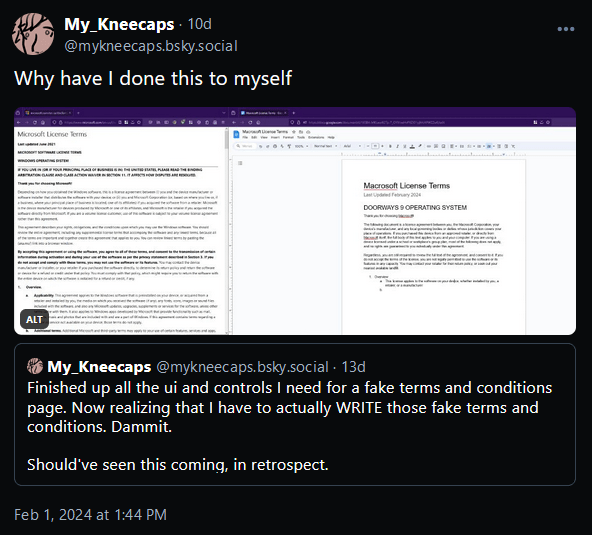
I decided that it all had to be readable. Not even good, necessarily – but readable. The consequences for that? The next five days of my life.
Part 2: The Pointless Things
This is the sort of balancing act that pops up frequently in game design. Naturally, as a creator and (presumably) enjoyer of games, you want to make something that’s as fleshed out as possible – to pay attention to every little detail. Those little things can really make your game special, after all!
Unfortunately, the thing about the little things is that they rarely are little – on the development side, at least. Everything you want to add to a game – no matter how small and insignificant it might seem – is a matter of time and labor. Easter Eggs will not merely will themselves into being; someone has to put them there, and that person is likely going to be you or your teammates.
Or modders, I suppose. But banking on fans to make your game for you is kind of a bad development strategy. And a rather presumptuous one, at that.
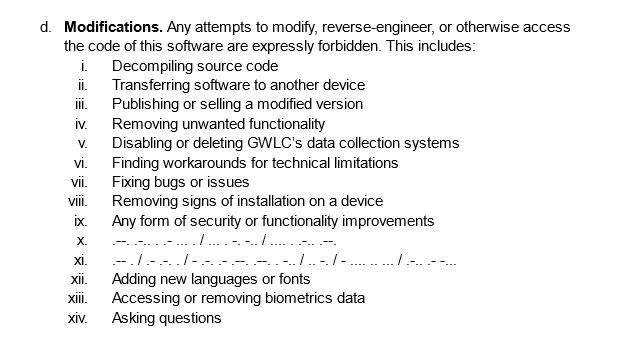
No? Just me?
This is, incidentally, one of the more notorious struggles involved in creating big, open games. You really only have so many resources at your disposal to begin with, and the more that goes into optional or secret content, the greater the risk of all that work just being… missed. It’s not even that it’s wasted, necessarily, as you’re still adding something to the experience. It’s just yielding a result far lesser than the effort that went into creating it.
That said, it’s not really even about the size of a game, so much as the specifics. Areas like art, rendering, and physics are places where even the littlest things can easily alter the feeling of an experience – which can get really, really irritating when you’re aiming for something specific. It’s easy to get bogged down in the details, regardless of how “simple” the core of that experience is.
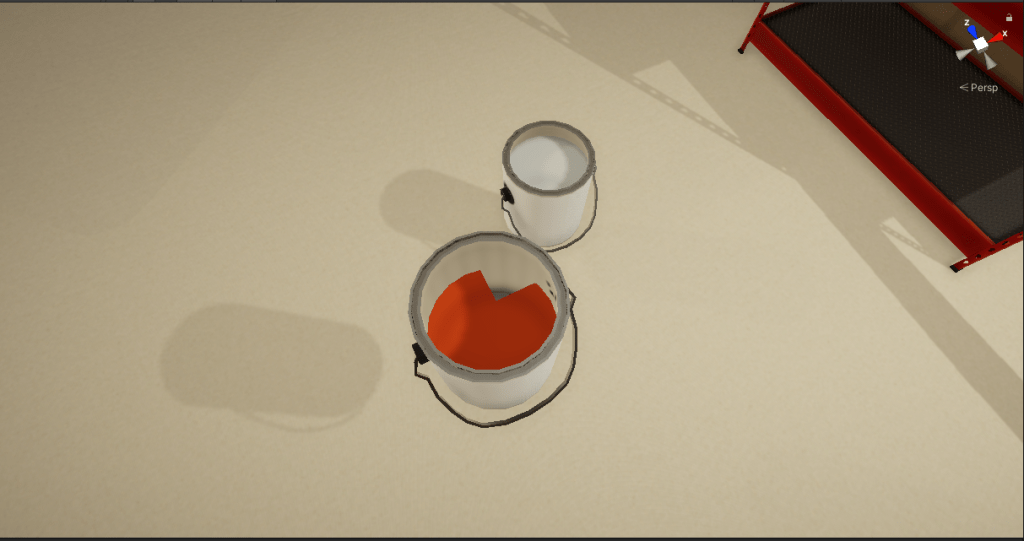
The result? I still have a desire to chuck something out a window every time I see a paint can in the wild.
Doorways 9, for its part, is by no means an open-world game, nor do I have any aspirations of making it one. Yet.
However, I’d say my little adventure in “license-writing” demonstrates a bare-minimum scenario of getting skewered by the details. What I was doing here was in no way technical, and had only the tiniest bit to do with gameplay. Even calling it “aesthetic” feels like a bit of a reach; it was a nothingburger – an extremely minor detail that I wanted to include purely because I wanted to.
And then, I spent several whole hours of my life on it.
Do I regret that? No! It is, however, an objectively inefficient use of time, which I can only get away with on a part-time indie schedule – not to mention a little boring at times. As I said earlier, it’s one of those parts of game development that makes you wish you could simply will it into being, skipping ahead to the more interesting parts of the job.
…
“Oh. Right.” Andrew said, looking down at the unwanted chatbot ad that had affixed itself to his search bar.
“It’s 2024.”
Part 3: The Elephant in Literally Every Creative’s Room
I freely admit that – about one-third of the way into writing my fake legal document – I began to lose my mind a little bit.
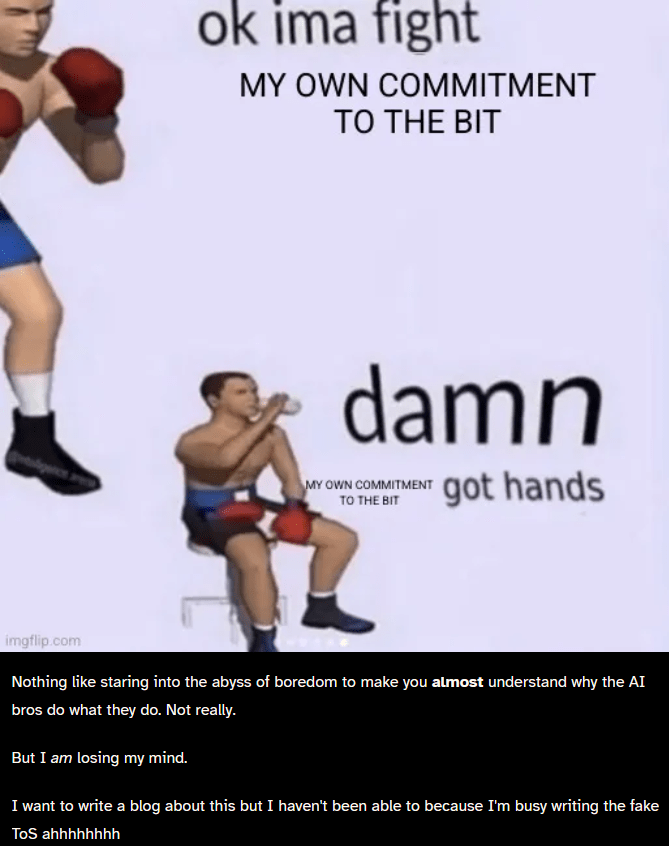
AKA: the reason why this blog post took so long to come out.
Obviously, that image is a joke. That said, it does reflect something that was on my mind while I was working on this: This is what the AI tools are supposed to be for, right? Work that’s:
- Not incredibly significant to the project
- Takes a disproportionate amount of time
- Already imitating an existing document
And, most importantly:
- Frequently very boring
I mean… yeah. In theory, what I was doing is the ideal use-case for these sort of tools. It’s filler – work that’s not super important to the player experience, aside from the fact that something has to be there. So why not use them?
…Several reasons, actually.
The most obvious reason is that I’m kind of stubborn when it comes to things that aren’t important. There’s no stakes here, and I planned to write the thing – so I was damn well going to write the thing. Full stop.
The more serious reason is that I’m not looking to steal anyone’s work, directly or otherwise. The AI we’d be talking about for this sort of task would be some sort of language model, which would, definitionally, be trained on someone else’s language.
Whose language? I don’t know. That’s the problem, really. Potentially using someone else’s work without permission or credit seems rude at best, and criminal at worst.
The biggest reason, though, is… it would just defeat the whole point of creation to begin with, wouldn’t it? Like I said before: this page of text we’re talking about is functionally filler; the only value it has is whatever I put into it. It’s not very important to the game overall as it stands, but having a machine write it in my stead would make it literally purposeless.
I’m not sure I entirely agree with the idea that AI can’t be used to create art. But in my mind, the potential artistic value in AI is found in the things that go well beyond the ability of humans to create alone.

Putting aside the issues of ethics and theft for a moment (which, to be clear, are very important and should not be put aside in any discussion of their actual use), I find that AI is creatively interesting when treated as a machine, rather than as a cheaper substitute for the artistic process.
A game like Suck Up! (2023), for example, which uses AI to “converse” with the player, creates an experience that is fundamentally different to what you would get from a handcrafted dialogue sequence. It feels more like a toy to be played with on its own than an attempt to cynically replace the writing process – and feels less creatively bankrupt than a lot of other AI projects as a result.
I’d like to stress again that this is not an “AI is fine, actually” argument that I’m trying to make. There are clearly many, many, many examples of ethical problems with it’s use already, and I am most certainly not an authority on it. My only point is that, if you look hard enough, you can see a creative use for a technology like this.
Maybe.
But that theoretical use-case? That’s not what I would have been doing here. That would have been simply skipping part of the creative process – and, by extension, stripping it of it’s main value.
Part 4: I Regret Nothing (Within a Very Specific Context)
So… do I regret spending several hours on an absolute nothingburger of a text?
No!
…Well, maybe a little bit, if I’m being honest – but only in the sense that I could have done it better.
Overall, though, I’m glad I did it – if for no reason other than the experience of having done so. I have never in my life paid such close attention to Microsoft’s license agreement – despite using their software constantly – nor have I ever tried to write anything mimicking the style of it before now. It’s not a super useful addition to my skill-set, certainly – but it was something worth thinking about, which I likely wouldn’t have otherwise. And clearly I did find myself thinking about it – because I now find myself several hours into writing about it here!
The joy of creativity is found in the ups-and-downs of actually creating – and all the learning that comes with it! As down as those downs can be sometimes, I’m certainly in no rush to sacrifice that joy.
Fin.
Aaaaaand… that’s all I’ve got, really. My brain is officially tapping out of this whole “writing” thing right about now. I considered uploading a link to my entire fake ToS as a way of capping things off. But, as I said, I’m increasingly trying to hold parts of the game closer to my chest, so you’ll just have to settle for a preview right now:
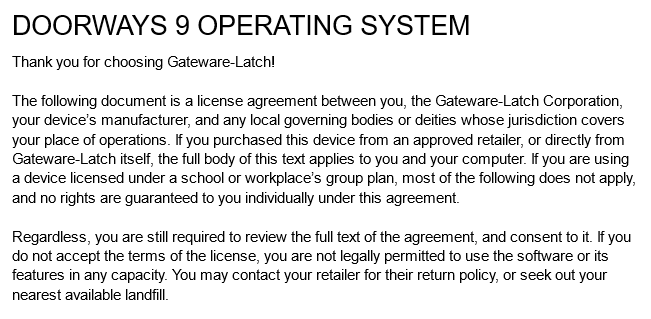
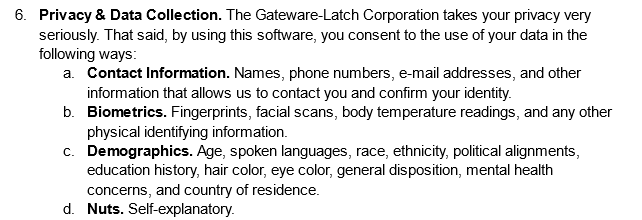
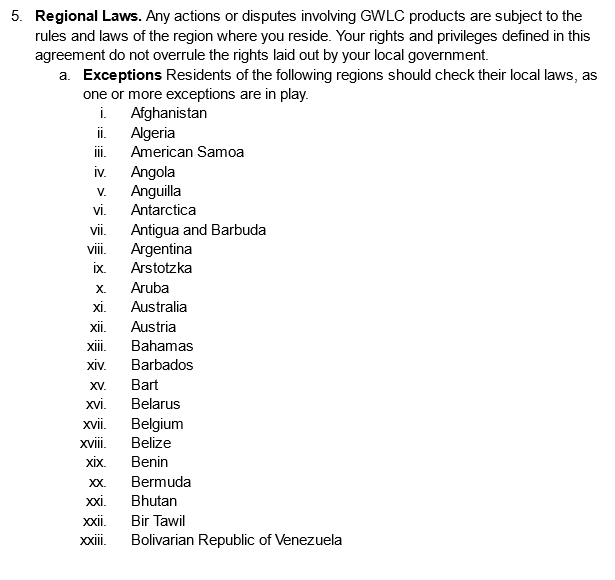
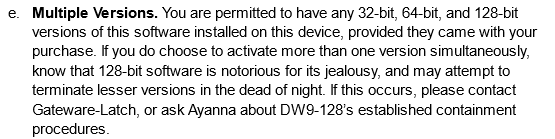
You might note that I changed the company name here. It turns out several hours of google trying to autocorrect your words to “Microsoft” will make you absolutely sick of them, so I’m trying out some different ones 🙂
If you made it this far… thanks for reading! I’m going to be trying to get my next post out in a shorter time frame. We’ll see about that.
Houskeeping matters:
- BlueSky recently opened up – no invites required! I’ve been over there for a few months now, and I’m posting gamedev stuff there in lieu of twitter. If you care about that sort of thing.
- It occurs to me now I’ve been neglecting my YouTube channel. I should probably do something over there, too, shouldn’t I?
Anyways… have a good rest of your day!
 The Chep Site
Leave a comment