
There are no spoilers for Shadow of the Erdtree in this article.
So… ELDEN RING: Shadow of the Erdtree is finally out, bringing with it a truly titanic wave of game design discourse. For two weeks, it has been crashing down upon every social media platform that I inhabit – which is unfortunate, given that I’ve got no real interest in any of it.
I’m enjoying playing through it at my own pace, and there are, of course, plenty of things for people to critique or dislike about it. Someone please tell the YouTube algorithm to stop recommending me videos of people screaming over it.
That said, a couple of days ago, YouTube did manage to show me something worth thinking about: a community post by FromSoftware lore aficionado Last Protagonist.
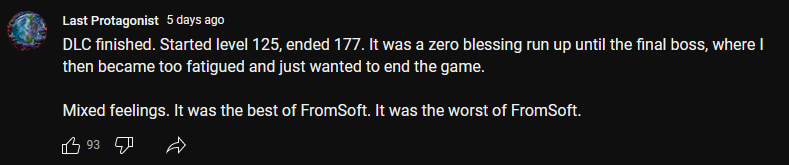
Now, this is not a blog about his opinions on the game, my opinions on his opinions, or anything like that. It did, however, make me do a bit of a double-take.
“It was a zero blessing run up until the final boss…”
Huh.
For anyone unaware, the “blessings” he’s referring to here are Scadutree Blessings, a new mechanic in Shadow of the Erdtree used to increase the player’s strength in combat. They are, according to the game’s publisher, the intended way for players to progress through the expansion. Not using them seems… painful, potentially.
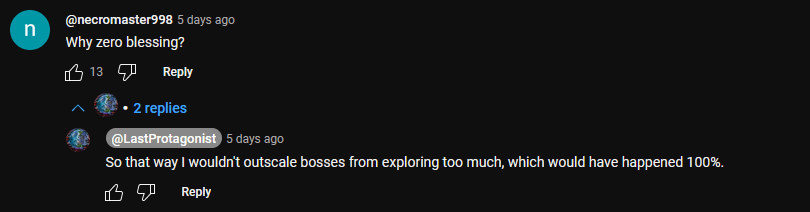
Many people were not so polite.
Don’t get me wrong – it’s a perfectly valid way of playing the game. No complaints from me.
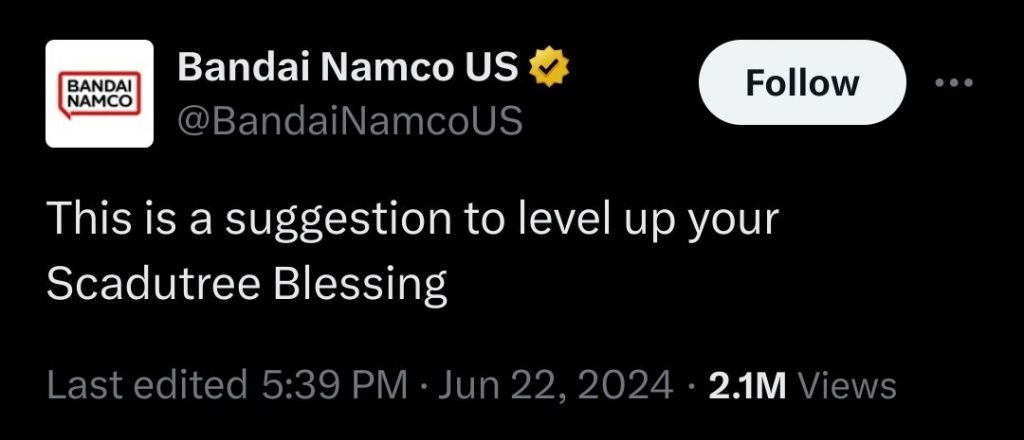
It did get me thinking, though – because this isn’t the only case of a player not using these blessings. There’s a lot of them, actually. So many that the game’s publisher put out a PSA, gently encouraging players to do so.
And that’s… a bit weird, isn’t it? That so many players would miss, or even deliberately avoid something intended to be core to the game they’re playing?
I think that at least part of what’s going on here is some classic Game Design Trickery ™. People see an (ostensibly) new, “optional” mechanic, and either don’t look into it, or want to experience the game without it first.
But it’s not particularly optional.
In fact, I’d argue that it’s not an especially new mechanic at all.
PART 1: Numbers in a Trench Coat
An alarming amount of game design is just finding new ways to dress up numbers. When you really boil it down, most things in games are just math, with numbers and formulas serving as a mechanical underpinning. In role-playing games like ELDEN RING, they’re the basis for expression – a set of attributes defining what a character can do, and how well they can do so within the rules of the game.
They are also – in many cases – pretty freakin’ arbitrary.
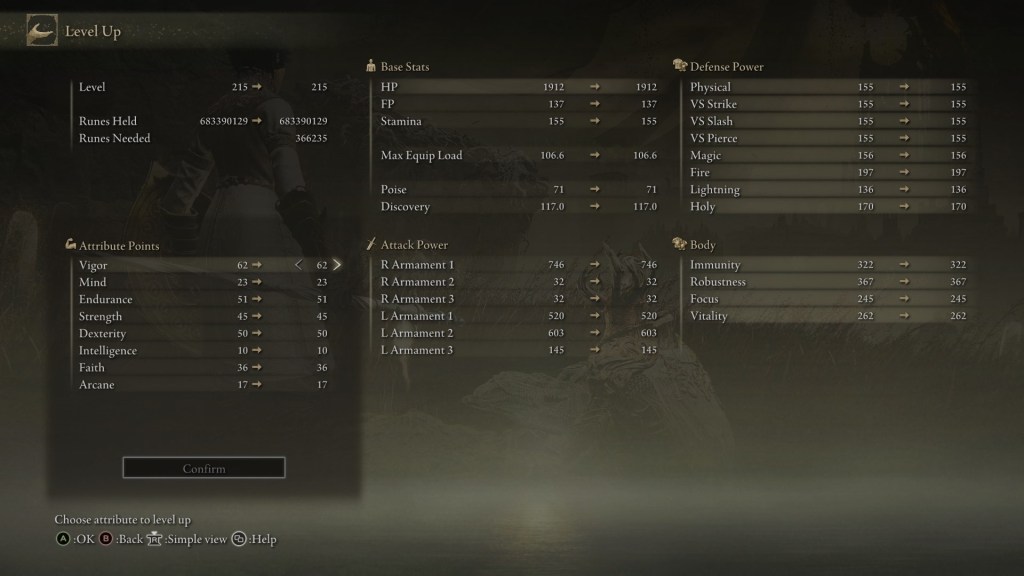
I mean, the calculations involved aren’t arbitrary, as far as the rules of the game go. Their meanings, in terms of story and experience? That’s where it immediately gets… wiggly.
A rather useful anecdote for this tumbled into my lap yesterday, when a friend (who is currently over 150 hours into ELDEN RING) looked at her stat block and went:
“What does my arcane stat even do, anyway?”
Put on the spot, the best response our group call could muster was:
It’s, like… the blood magic stat. And some dragon stuff? But not all of it. A bunch of it uses faith.
I mean… yeah. What is arcane? What are any of the stats?
With the physical ones, it’s fairly clear what characteristics are supposed to be represented. Strength is your physical strength, dexterity is your… dexterity. It’s not hard. In theory.
However, pretend for a moment that you don’t know anything about ELDEN RING. (If you already don’t know, congratulations! You get to skip a step). With no prior knowledge, what’s the distinction between your mind and your intelligence? What does it mean to have a higher faith than another person?
And again – what is an arcane?
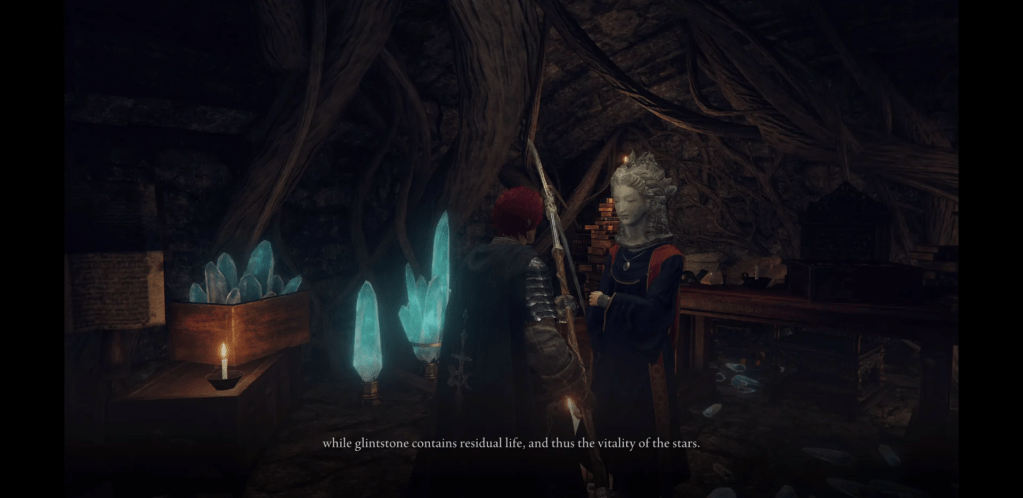
Is this rock, paper, scissors?
These numbers derive their meaning to us, as players, from the context in which they are presented. Stripped down to their barest forms, faith, intelligence, and arcane might as well be about as meaningful as the colors in of a card in UNO – a mechanical demarcation, serving only the existence of three “different” types of magicians.
Yet, they aren’t – because the game treats them as something more. They’re different sources of magic, tied to the gods, the study of the universe, and the… whatever arcane is derived from. They come from different cultures, appearing in the hands of different factions and creatures around the world, and bring that context to your character.
And, above all: they each represent a distinct piece of how the game plays.
PART 2: The Power of Runes
To that end, ELDEN RING‘s leveling system finds itself in a bit of an awkward position.
Levels – like the stats that comprise them – have an explicit meaning within the lore of the game. They are “the power of runes” – small shards of the titular Elden Ring, whose power governs the very laws of the universe. They are part of the player’s quest: to gather runes from around the land, and to use them to repair the shattered Elden Ring – restoring (or imposing) order to their collapsing world.
…In theory.

For all of their justification, levels are one of ELDEN RING‘s more naked systems, most frequently appearing to the player in the form of spreadsheets. They’re not exactly obscured, nor are they intended to be.
For the player’s purposes, they’re just levels, and they do what levels in any other game would do.
And that’s not a problem, really. This is a game! It’s not necessary to hide every little number from players. If anything, obscuring the nature of your leveling system would probably just make the game harder to comprehend.
…
Unless, of course, you had reasons to change what your levels mean.
PART 3: The Scadutree Shuffle
…Which brings me (finally) back to the point of all of this: these things right here.

All lore aside, Shadow of the Erdtree’s blessings seem to have a pretty clear mechanical purpose: to be a new method of increasing players’ strength, supplanting part of the role that levels fulfilled in the base game.
Why?
Well, for one: balancing your expansion around your existing level system could present problems. Two years out from the base game’s release, you have players coming into the DLC content at all different levels of strength – meaning that their starting points could be all over the place. How do you ensure that a player who rolls in at level 200 has just as good of an experience as one just over 100?
Simple: you make the number irrelevant. You make the difficulty of the DLC operate on an entirely different scale, so players are all (generally) starting out on the same footing. No one gets screwed out of an enjoyable experience, because the entry point is the same for everyone.
It’s a good idea! And a good approach to design, I think.
It does have some potential pitfalls, though. Namely: your “level” system for the DLC is no longer the level system, which can really change the way it’s perceived.

After all, “levels” are a pretty well-established convention across both physical and video games. Most gamers are likely to have some preconceived notions as to what their level ups will do, as opposed to the more nebulous definition of “blessings”.
Blessings also have their own tab in the menu, listed alongside the likes of craftable items and temporary buffs. They’re placed in specific locations across the map, more akin to item upgrades than runes (which are literally everywhere). They’re not totally out of line, as far as ELDEN RING’s systems go, but they are different.
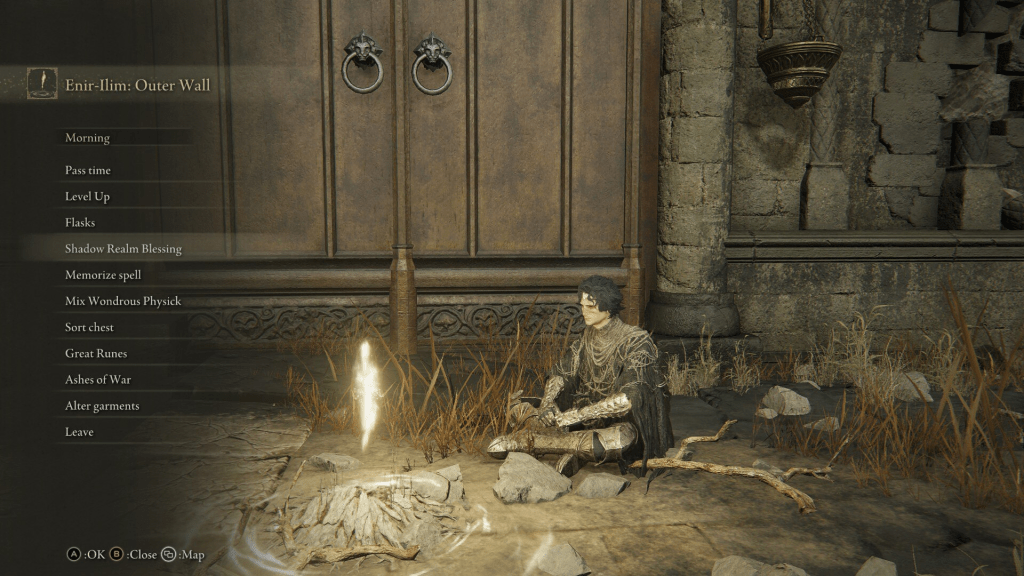
Sometimes, “different” is all it takes to befuddle a player.
PART 4: PARADIGM SHIFTED
Levels are, at the end of the day, numbers. In ELDEN RING, they’re numbers with a specific meaning to the player. You see runes on your screen, you use them to level up. They’re progress.
In Shadow of the Erdtree, they mean something different. Past a sufficient level, your runes in the don’t matter as much. A single Scadutree blessing gives far more in stats than an individual level ever could. Runes and levels are still progress – but only kind of. If you approach progress in the DLC according to the conventions of the base game, you’ll have a rough go of it.
And… that’s where I start wondering about some of that stuff from my intro section.
There are plenty of things that vocal FromSoft fans will famously prefer to avoid in their playthroughs.
…Magic.
…Summons.
…Happy endings to questlines.
I’m not here to litigate any of that. I don’t care. Do what you enjoy.
However, I do find it strange that blessings seem to have slipped between the same cracks as some more optional mechanics, given that they are – functionally – level-ups. They’re just stats. You collect them to make the numbers go up.
But – they don’t read that way. Or at least, they don’t read that way to some people. Enough that the publisher put out a reminder about them via twitter.
And y’know what? That’s totally understandable. ELDEN RING is huge, and people regularly go entire playthroughs without engaging with large swaths of its systems and content. The idea that someone would pick up a new item and go “I’ll toy with this later” is to be expected. It’s not as unavoidable as leveling up. Clearly.
So, are Scadutree Blessings a bad, poorly-communicated system, stapled onto the side of the game?
…
Uh. No? I don’t think so, at least.
As previously stated, I think that they’re actually a pretty neat solution to the DLC difficulty scaling, and I think it’s refreshing to have something different for progression. They’re potentially missable, sure – but their importance is regularly communicated to the player. It’s fine!
I just find the whole ordeal to be a fascinating little study in presentation and perception. Games designers opt for multiple types of progression in place of “just level-ups” all the time, for all sorts of different reasons. ELDEN RING is such a big game (with such a passionate following) that the effects of these small-ish changes on players are amplified – put on display for the entire internet to see. Willingly or unwillingly.
FromSoftware made different type of level-ups for their DLC, and it set some parts of the internet on fire for a bit. I think that’s pretty neat.
PART 5: You fools. You idiots. This entire post was about Fire Emblem this whole time. I tricked you. I’ve shifted the paradigm in the essay about shifting paradigms.
I’d like to personally thank FromSoftware for giving me a minor internet kerfuffle involving this topic.
I was going to write about it eventually, purely because of an experience I had with Fire Emblem a few years ago. So again: thanks for the justification, guys.
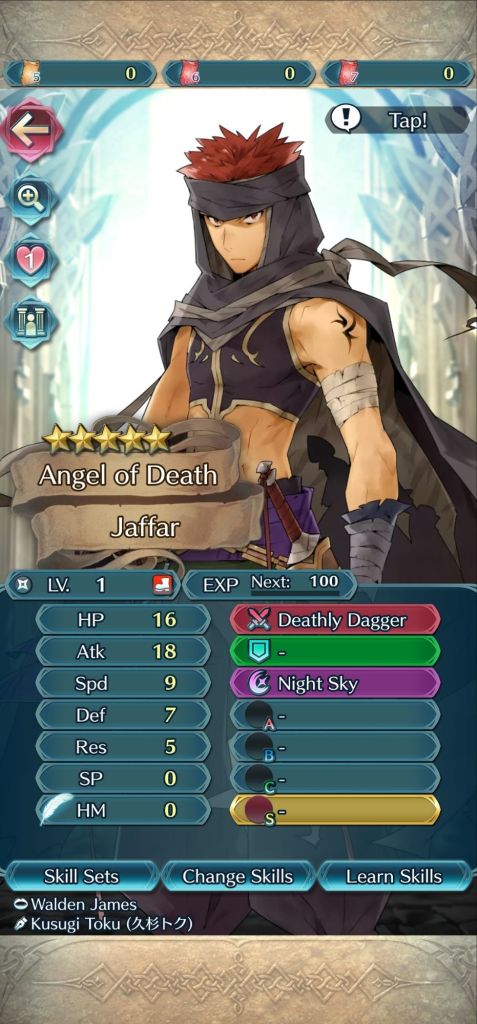
So, Fire Emblem Heroes is a mobile game spin-off of Nintendo’s Fire Emblem series. I have a lot of friends that are really into it – even more so in the past.
As pictured above, Heroes uses a pretty standard RPG stat setup, including levels. When I was first looking into the game’s character-building, I saw that characters capped out at level 40. It seemed like kind of a strange number to end on to me, personally – but that’s fine.
Then I looked a bit further and I-
…Uh. Hmm.
Hey. Fire Emblem? Whatcha got there? What are those… other options?
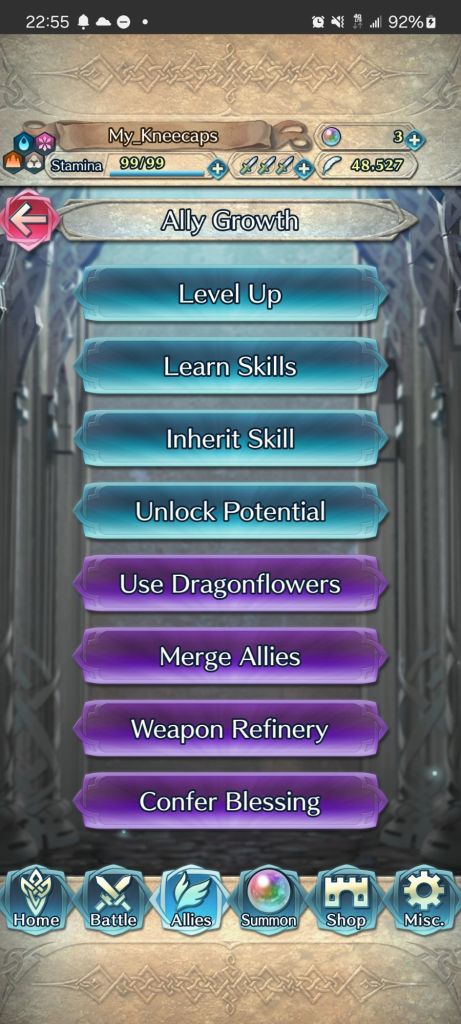
So, Heroes has more than one system for increasing a unit’s strength, beyond just the level cap. Several systems more.
For one, there’s the dragonflowers: a set of collectible items that players can spend increasing amounts of to increase their heroes’ stats. They’re a little similar to runes in that regard, actually.
There’s also merges, which are a bit more complicated to explain. Essentially, though they involve combining two copies of the same unit, at the same level, to increase one’s power. I’ll let the wiki do the in-depth explaining of how that works here. Feel free to only skim these.
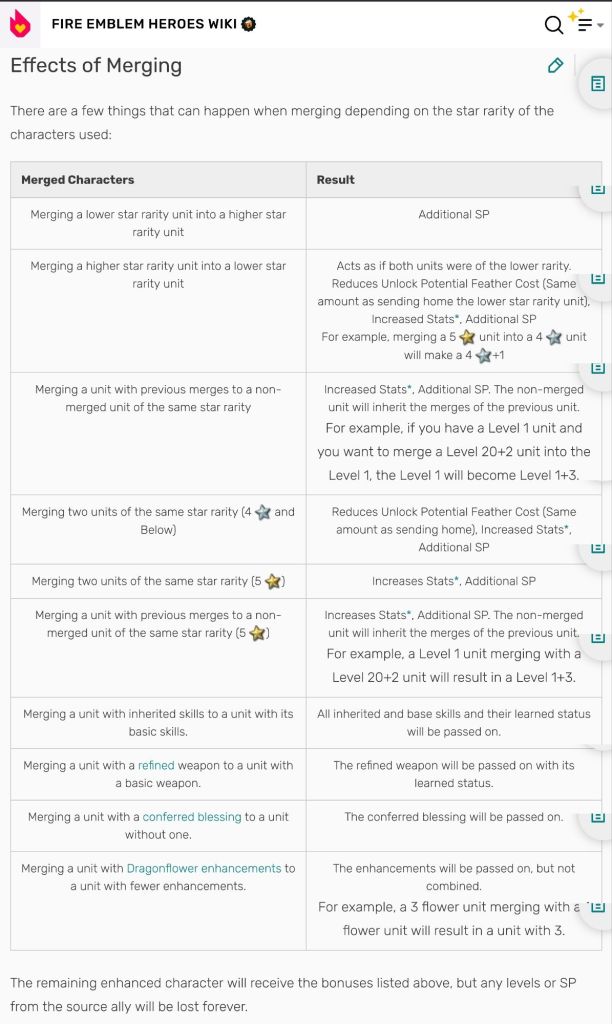

That is… something. Like level-ups, these are basically just increasing a hero’s stats – now with the added requirements of additional copies of a unit.
Also, in one of those pictures, it says that merges go up to 10. With 40 normal levels, wouldn’t that just mean that each character functionally has 50+ levels?

Oh. It literally gets appended to the level amount.
…
I do not understand why this game is this way.
I mean, I do. Fire Emblem Heroes is a gacha game. The entire gameplay loop revolves around collecting things (heroes, mainly). Having a progression system that involves (and incentivizes) collecting makes sense. For Heroes, I’d even say that it works well, as a way of gathering different skills for customizing units.
However, when you strip away the language of the game, and look at it for what it actually does? Functionally adding an extra 10-20 to each unit’s level cap, with all sorts of different requirements to get there?
It’s just so… bloated.
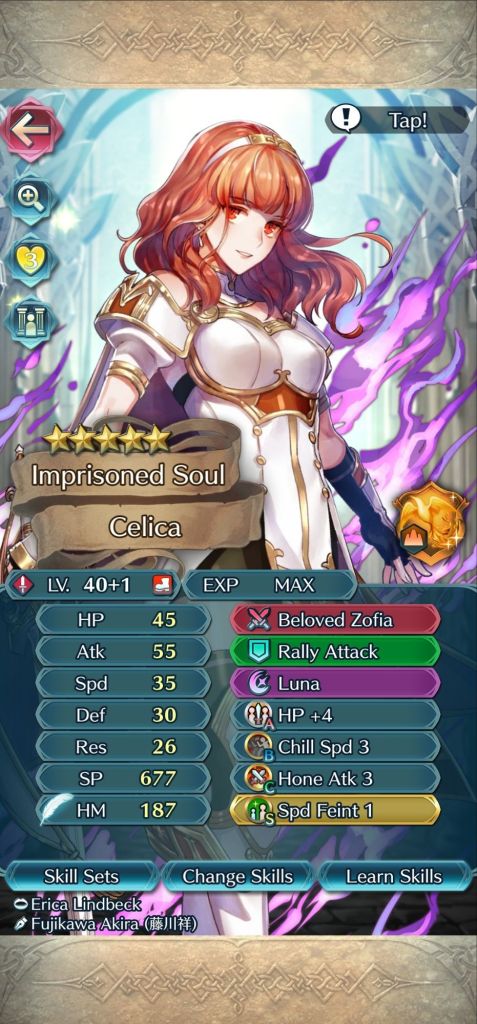
To be clear: it’s not that having different requirements to progress is bad. As I said for Shadow of the Erdtree‘s blessings, I like the variety that an alternate system like that can bring.
This, however, just feels so… convoluted. There’s so many small systems – all presented separately – which seem to serve the same function as leveling up. It’s so much more to do, merely in the name of a couple extra stats.
Heroes’ distant, distant Nintendo cousin, Pokémon GO, is also collection-focused, and likes to throw hurdles at the player that tie into that. GO‘s hurdles, however, are straightforward – sticking close in design to the game’s other systems.
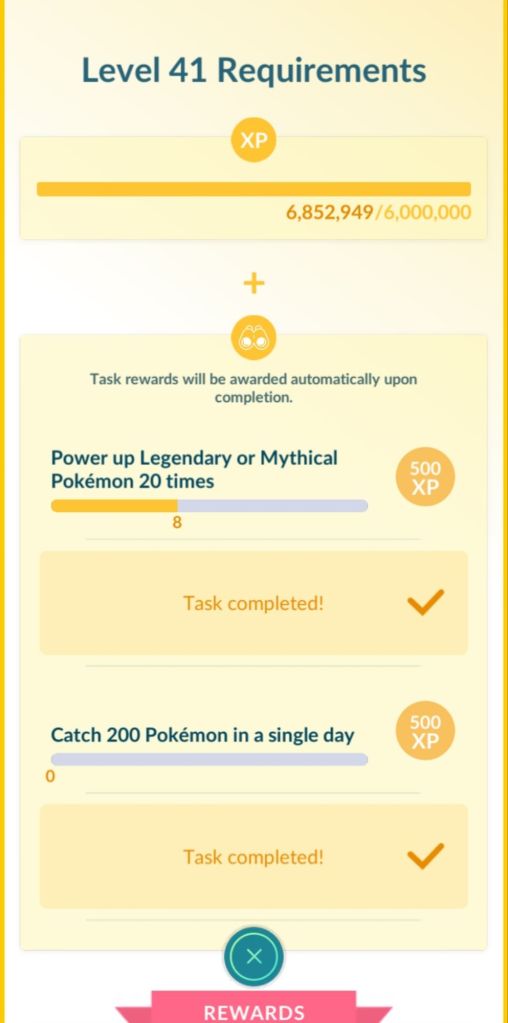
When you reach a high enough level, you start getting quests you have to complete before you can level up again. That’s it.
There’s an alternate universe out there where Heroes‘ heroes hit level 40, and keep going. Perhaps they could start requiring a certain number of dragonflowers, or sacrifices of duplicate units to do so. The point is: all of the information that it’d take to grow your unit to its full potential could just be right there, instead of spread across so many different menus.
If Scadutree blessings felt a bit retrofitted onto ELDEN RING, these things feel loosely stapled to Heroes’ sides.
I just find it… bizzare.
PART 6: The End
At the end of the day, I don’t think any of the game systems that I talked about here are particularly ruinous. Every game mentioned here is, in fact, some degree of mega-popular – with good reasons. I don’t demand any changes, nor am I asking anyone to stop (or start) enjoying something.
It’s worth considering, though. I know I’ve found myself doing so, since bouncing off of Fire Emblem Heroes‘ progression systems. Witnessing others undergo something comparable with Shadow of the Erdtree only added fuel to that mental fire.
The point is that these systems are all “little” things, in the sense that I would not describe any of them as the “main” part of their game. They’re scaffolding – built around their main progression systems to modify or supplement an experience.
And no matter how enticing the core of the game is, they will change the way it is perceived.
WARNING!
There is a single image of a late-game area in Shadow of the Erdtree ahead.
No enemies or anything. You’ve seen it if you watched a story trailer.
If it really bothers you – feel free to stop here 🙂
In the time it took me to write this out, I managed to finish Shadow of Erdtree.
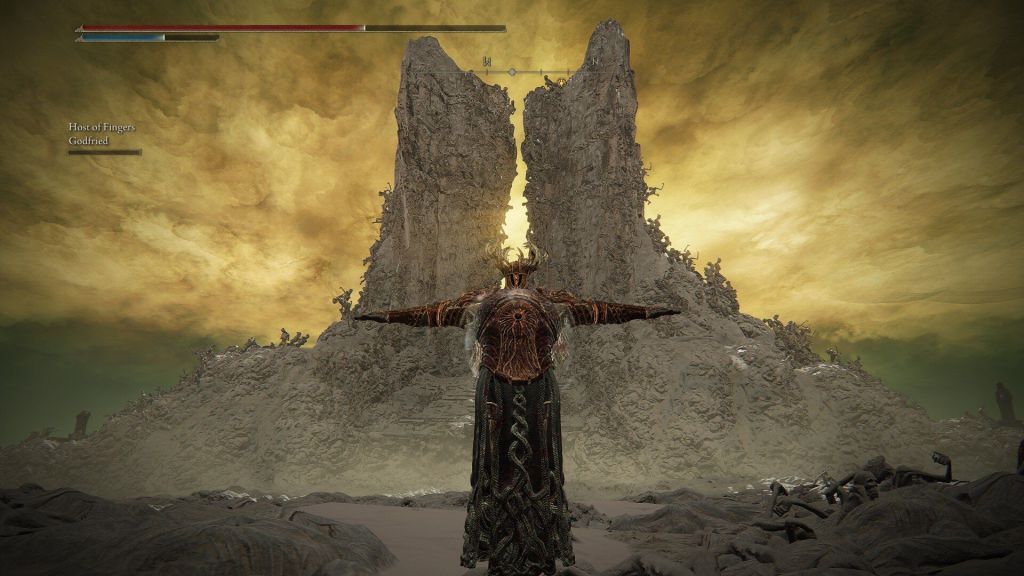
I didn’t intend to time it out that way. I was about to head out for a big vacation, thought I’d try to get some co-op time in, and just… won.
Funnily enough, the speed of my playthrough had a lot to do with what Last Protagonist was trying to avoid. I was on my original save file, which was significantly over-levelled once the blessings were applied.
I just didn’t really care! This particular playthrough was always more about messing around with friends than the challenge – though I’ll probably go back for that experience at some point.
That said – he wasn’t wrong. It can happen. Consider this a little PSA, if you’re trying to avoid that.
But anyways – that’s enough of that for now. I am literally in a cornfield as I’m writing this, and I’m going to go back to enjoying it.
Though I will definitely still be thinking about ELDEN RING.
Have a good one, and thanks for reading.
 The Chep Site
Leave a comment